Training.

Workshops.

Advocacy.

Sustainable progress against esophageal cancer depends on building local expertise, expanding practical treatment access, and ensuring the disease remains visible to decision-makers. Theseefforts focus on turning knowledge into action and impact.

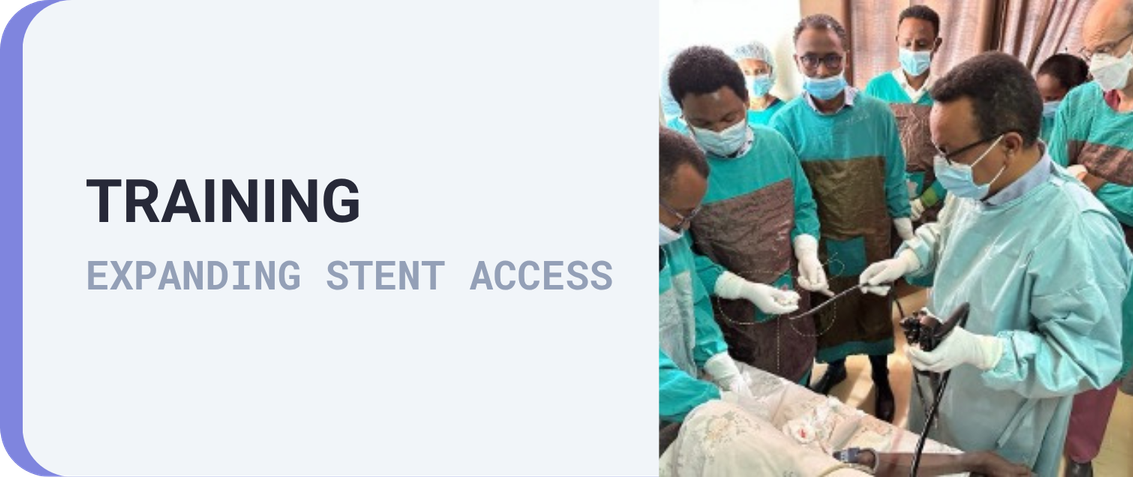
AfrECC’s signature training program is the Stent Access Initiative.

Nearly all esophageal cancer patients in Africa come to the doctor when they are almost completely obstructed and cannot swallow liquids, including their own saliva. At this advanced stage, they cannot be cured but they can be significantly palliated by insertion of a self-expanding metal stent. These stents enable them to swallow all liquids and some solids, providing nutrition and dignified palliation, which allows them to spend quality time with family and friends.

The AfrECC Stent Access Initiative,sponsored by Boston Scientific Corporation and Olympus Corporation,provides access to discounted stents and conducts workshops that train local endoscopists to insert stents safely and accurately. Since 2018, this hands-on training initiative has conducted 19 workshops in 8 countries, training 66doctor-nurse endoscopy teams and stenting 344 patients.

In addition to procedural training, AfrECC supports broader clinical education and professional development.

  • Regional workshops focused on early detection, endoscopy skills, pathology, oncology, and multidisciplinary cancer care
  • Mentorship programs connecting regional clinicians with international experts, including live video tutoring during procedures and joint pathology review of biopsy slides.
  • Capacity-building activities to strengthen long-term sustainability of local cancer programs.

AfrECC and the AfrECC Foundation actively promote esophageal cancer advocacy at local, regional, and international levels.

Advocacy Goals:

  • Raise Awareness: Increase recognition of ESCC among physicians, at-risk communities, policymakers, and global health stakeholders.

Effective advocacy is essential to mobilize resources and ensure sustainable, long-term impact.

  • Promote Early Diagnosis: Educate     both clinicians and communities to encourage earlier presentation, timely     referral, and improved outcomes.
  • Influence Policy & Funding: Advocate     with ministries of health and international funding agencies to expand     access to treatment, palliation, and research investment.
  • Support Evidence-Based Policy: Promote     research-driven strategies for prevention, screening, and palliation

Click to view PDF